From frigid individualism to warm collectivism: the rhetoric of Zohran Mamdani's inaugural speech
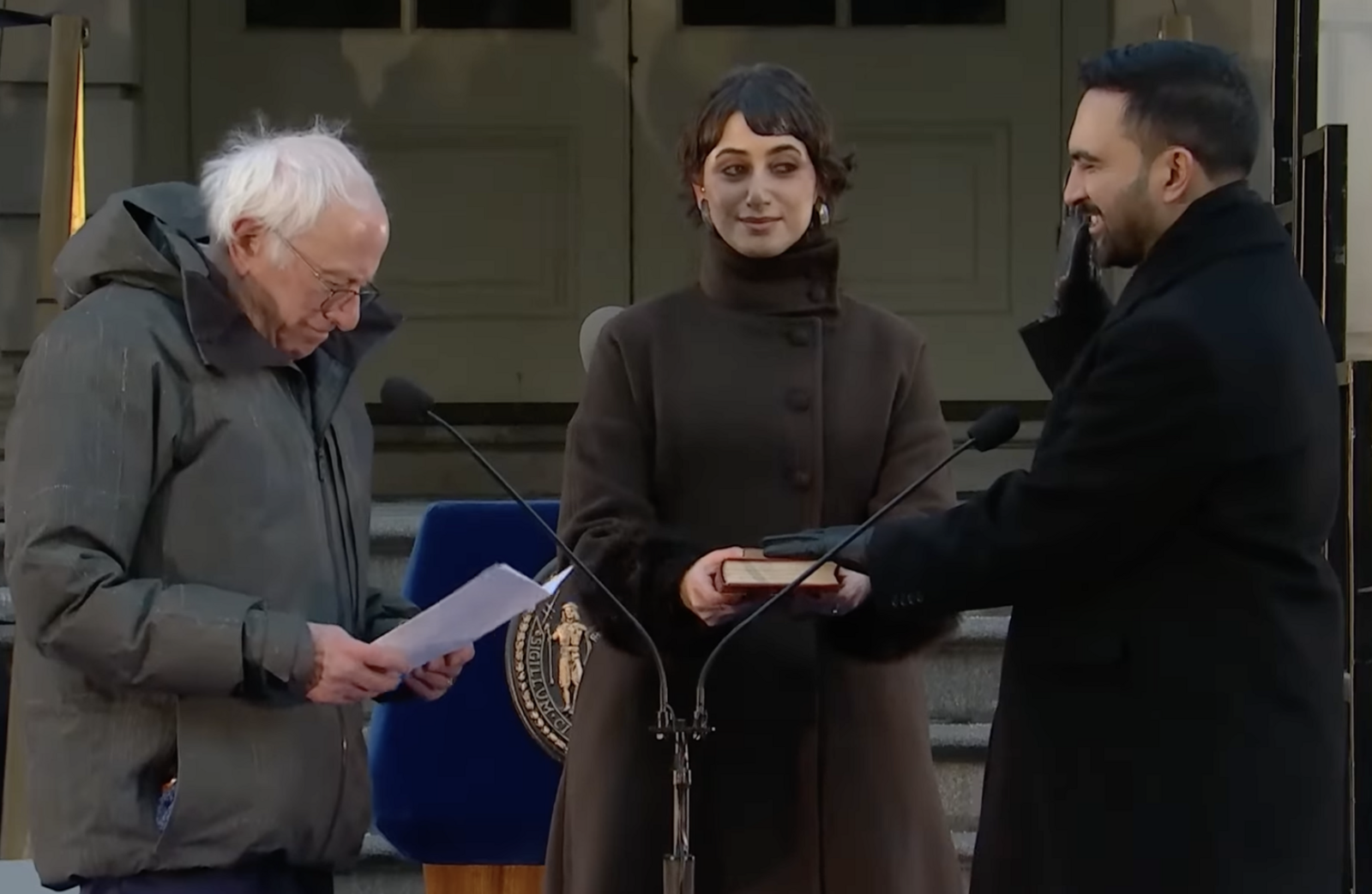
It was indeed a frigid New Year's Day when Zohran Mamdani was sworn in as the new mayor of New York City – there were plenty of spectators, and they looked really cold, but that didn't stop them from cheering. The theme of Mamdani's remarks was the start of a new era in New York, and change driven by a love for the city itself. There were so many rhetorically interesting moments, I can't resist writing about them.
If you haven't watched it yet:
I used the transcript from the New York Times for this post.
First things first, the structure of the speech (I think outlining a speech tells you a lot about what the speaker is up to):
- Introduction: Setting the scene
- Section 1: Governing with ambition
- Section 2: Who does New York belong to?
- Section 3: A new shared story of New York
- Section 4: Mamdani's personal history as a New Yorker
- Section 5: A government of New York, by New York, for New York
- Closing exhortation: The work has just begun
If you think that's a lot of "New York," you're right: 42 mentions of New York and New Yorkers in what is not a long speech by any means. The city itself, a sense of place and affection for it and commitment to serve it, is the main theme tying the speech together.
Introduction: Setting the scene
"Today begins a new era," Mamdani begins. Probably most inaugural addresses begin this way, but in Mamdani's case, it was a particularly crucial campaign promise – the promise to bring a new Democratic Socialist ideology of governance to City Hall. If he succeeds, this might be the title given to the speech by history books, as I suspect he knows.
"I stand before you" moved and humbled, he notes, but it's not standing before an audience that he wants to emphasize. Rather, he then emphasizes standing with the audience at City Hall and watching at home, and all the million plus voters who put him in office. "I do not stand alone," he says, followed by five sentences beginning with "I stand alongside..." (a rhetorical figure called anaphora, repeating an initial word or phrase). Mamdani characterizes his leadership style as anchored in solidarity, not in domination or a cult of personality.
Here we start to see two motifs emerging. One is massive numbers of people. "Tens of thousands" gathered, "countless more" watching, "over one million" Mamdani voters. New York's population is vast; while it's just one city in a nation of many cities, it is a HUGE city, and therefore significant in the political landscape. But this focus on numbers is also about expressing Mamdani's political commitment to the good of the many, not the few.
The second motif that begins here is a seemingly exhaustive list of different kinds of New Yorkers. They're in different places - Flushing, East New York, LaGuardia, Mott Haven, El Barrio, Brighton Beach, Rossville, Woodhaven, St. Albans, and Bay Ridge. They have different occupations: construction workers, food vendors, cab drivers, healthcare workers, transit workers. They speak different languages and follow different religious traditions (or none at all). The exhaustiveness is the point: New York has some of everything.
Both of these motifs are important on their own, but they're more important in combination, as we'll see in Section 3: A new shared story of New York.
We get our first big sound byte in the speech, a notable departure from the tenor of the current presidential administration:
I know there are some who view this administration with distrust or disdain, or who see politics as permanently broken. And while only action can change minds, I promise you this: If you are a New Yorker, I am your mayor. Regardless of whether we agree, I will protect you, celebrate with you, mourn alongside you, and never, not for a second, hide from you.
And then a ceremonial round of thank-yous to highlight some particularly important people sharing the dais with Mamdani: labor and movement leaders, musicians performing at the ceremony, and key political figures. There's Governor Hochul, who will be a colleague of sorts, and his predecessor Mayor Adams. There's he two congresspeople representing New York City, Nydia Velazquez and AOC. Bernie Sanders gets a special shout-out as "the man whose leadership I seek most to emulate." And then Mamdani thanks his campaign, transition, and mayoral teams. No mention of his opponent Andrew Cuomo, whom he promised never to mention again in public in his victory speech on Election Night, and no mention of Chuck Schumer, who was also sitting on the dais behind him but had not endorsed him as a mayoral candidate. Mamdani is drawing boundaries around his coalition and drawing connections to important role models. With Adams, Mamdani appreciates his predecessor's rise from humble origins and breaks the tension gracefully with a joke:
He and I have had our share of disagreements, but I will always be touched that he chose me as the mayoral candidate that he would most want to be trapped with on an elevator.
Section 1: Governing with ambition
Back to the "new era" theme. If you thought Mamdani was going to temper his rhetoric and try to settle into mainstream politics...nope.
In writing this address, I have been told that this is the occasion to reset expectations, that I should use this opportunity to encourage the people of New York to ask for little and expect even less. I will do no such thing. The only expectation I seek to reset is that of small expectations. Beginning today, we will govern expansively and audaciously. We may not always succeed. But never will we be accused of lacking the courage to try.
To those who insist that the era of big government is over, hear me when I say this: No longer will City Hall hesitate to use its power to improve New Yorkers’ lives.
That last part really made me sit up straight. I don't think I've ever heard a word of praise of big government from an elected official in my life. I've grown up in the era of neoliberal Democrats catering to the center and to independents, trapped in Reagan-era framing of government (and civil servants) as a bloated bureaucratic behemoth. (Even while Republicans are increasingly using legislation to dictate people's personal lives, the very specter usually evoked by critiques of "big government.") This really is a clear departure from the status quo, hearkening from Democratic Socialist political philosophy. And it seems to me to be a direct rebuttal, not of Mamdani's opponents or New York voters, but of pundits and journalists and political commentators. They are an unnamed but crucial audience for the speech, and some of Mamdani's most prominent detractors. In the next section, he promises that "City Hall will deliver an agenda of safety, affordability, and abundance," incorporating the liberal buzzword into his calls for affordability as if to say, yes, I can do what you say I can't.
Section 2: Who does New York belong to?
This leads into a section grounding Mamdani in a tradition of New York mayors who were the exception to the rule in trying – often unsuccessfully – to reduce inequality and use political tools to ensure that working class New Yorkers could live a decent, dignified life. The point is that Mamdani's new era is not totally radical or unprecedented or foreign: it's a part of New York's history and a return to an old idea, never quite realized.
We will provide our own answer to that age-old question — who does New York belong to? Well, my friends, we can look to Madiba and the South African Freedom Charter: New York “belongs to all who live in it.”
Section 3: A new shared story of New York
Together, we will tell a new story of our city.
This will not be a tale of one city, governed only by the one percent. Nor will it be a tale of two cities, the rich versus the poor.
It will be a tale of eight and a half million cities, each of them a New Yorker with hopes and fears, each a universe, each of them woven together.
So literary! So lyrical! Maybe we're seeing the influence of his mother Mira Nair's cinematic sensibility or his wife Rama's artistic insight here.
We get back into lists of different kinds of New Yorkers, and cheers go up from segments of the audience as they recognize themselves (surely the intent here). But we have to hold two ideas together: they're all distinct, AND they're all New Yorkers. Everyone an individual, everyone a part of the collective.
And a little tinge of postcolonialist academia from Mamdani's father: the majority of New Yorkers will be represented by Mamdani's government even if they don't use the language of power brokers and politicos. "For too long, those fluent in the good grammar of civility have deployed decorum to mask agendas of cruelty."
Mamdani also returns to the sense of joy and community that defined his campaign and inspired a hundred thousand (!) people to volunteer to support it:
And if for too long these communities have existed as distinct from one another, we will draw this city closer together. We will replace the frigidity of rugged individualism with the warmth of collectivism. If our campaign demonstrated that the people of New York yearn for solidarity, then let this government foster it. Because no matter what you eat, what language you speak, how you pray, or where you come from, the words that most define us are the two we all share: New Yorkers.
A unifying message is typical for an inaugural speech, but this is a novel and artful unifying message. The figurative language of "We will replace the frigidity of rugged individualism with the warmth of collectivism" is so striking, like one of the sententiae or one-liners that Roman rhetoricians collected in textbooks. It is also transparently and unapologetically Socialist. Mamdani says that while some pundits described his campaign as coming "from nowhere," in New York, "there is no nowhere and there is no no one. There is only New York, and there are only New Yorkers." No one invisible, no one disposable, no one disenfranchised.
We get our first concrete policy agenda items: reform property taxes, create a Department of Community Safety to support police and provide mental health interventions, take on bad landlords, and clear away red tape for small businesses. But then we zoom in for a personal moment. This speech is not catering to policy wonks.
Section 4: Mamdani's personal history as a New Yorker
Mamdani is so compelling not only because he is so charismatic but because he comes across as deeply authentic – he has a long track record of real commitment to the same people and issues, long before he was in the public eye, but he also just sounds like a real person. Logos (rational argumentation) and pathos (heightened emotions) do a lot of the heavy lifting in rhetoric, but don't forget about ethos, the orator's character and credibility.
Here, he depicts his childhood and deep sense of the places in New York that formed him, stepping down from formal and figurative language into a colloquial register, with a healthy dose of humor and his trademark grin:
This is the city where I set land-speed records on my Razor scooter at the age of 12. ... The city where I have gone on hunger strike just outside these gates, sat claustrophobic on a stalled N train just after Atlantic Avenue, and waited in quiet terror for my father to emerge from 26 Federal Plaza. ...
To live in New York, to love New York, is to know that we are the stewards of something without equal in our world. Where else can you hear the sound of the steelpan, savor the smell of sancocho, and pay $9 for coffee on the same block? Where else could a Muslim kid like me grow up eating bagels and lox every Sunday?
It's vivid, sensory, emotional, affectionate but not whitewashed, hyper-specific and personal but also universally recognizable as New York. Love of the place in all its diversity, he promises, "will be our guide as we pursue our agenda."
Section 5: A government of New York, by New York, for New York
We emerge out of a nostalgic personal narrative into a policy agenda motivated by that nostalgia, and also tied to the history of the New Deal (again, he implies, his agenda is not as radical as you may have been led to believe). Universal childcare, a rent freeze, free buses. These were the greatest hits among his campaign promises – but that wasn't just cheap pandering and getting votes, he says:
These policies are not simply about the costs we make free, but the lives we fill with freedom. For too long in our city, freedom has belonged only to those who can afford to buy it. Our City Hall will change that.
The policies aren't good in and of themselves; they're part of a larger philosophy and ideology of governance. That ideology is Democratic Socialism.
We will transform the culture of City Hall from one of “no” to one of “how?”
We will answer to all New Yorkers, not to any billionaire or oligarch who thinks they can buy our democracy.
We will govern without shame and insecurity, making no apology for what we believe. I was elected as a democratic socialist and I will govern as a democratic socialist. I will not abandon my principles for fear of being deemed radical. As the great Senator from Vermont once said, “What’s radical is a system which gives so much to so few and denies so many people the basic necessities of life.”
We will strive each day to ensure that no New Yorker is priced out of any one of those basic necessities.
Sound impossible? Many pundits have said so. Don't worry – he has a response.
Closing exhortation: The work has just begun
What we achieve together will reach across the five boroughs and it will resonate far beyond. There are many who will be watching. They want to know if the left can govern. They want to know if the struggles that afflict them can be solved. They want to know if it is right to hope again.
I expected Mamdani to dismiss his critics with defiance or even scorn – isn't that what most politicians do these days? He doesn't. He imagines, underneath their skepticism, a tender spot of anxiety, a fear of hoping and being disappointed.
Mamdani began his speech by describing where and with whom he stood; he closes now by asking everyone to "stand with me" in helping him to deliver the agenda he was elected to implement:
The movement we began over a year ago did not end with our election. It will not end this afternoon. It lives on with every battle we will fight, together; every blizzard and flood we withstand, together; every moment of fiscal challenge we overcome with ambition, not austerity, together; every way we pursue change in working peoples’ interests, rather than at their expense, together.
Again, collectivism over individualism, the many rather than the few, in a tetracolon crescendo, a series of four repetitious phrases where each gets longer to build the drama. He names sobering examples of challenges the city is bound to face, no matter who their mayor is or how many votes he got. In addition to being philosophically consistent, he's also being practical: the main question about his administration is whether he'll be able to convert an electoral machine into a sustainable movement. To do that, he needs people to keep showing up and paying attention, not to pat themselves on the back for winning an election and abandon civic engagement until the next race. "The work continues, the work endures, the work, my friends, has only just begun."
It's remarkable to me how Mamdani managed to blend specialized political science terms and historical awareness, emotion, and broadly comprehensible underlying principles in the speech. It's all bound together with a love for the place he's going to lead, quite unlike the politics of grievance and focus on historical wrongs that critics of the left often complain about. I think this all plays into Mamdani's meteoric rise, and I do hope he succeeds, because he's right that the world will be watching.
Check out more posts like this: